2. Valve Regional Standings (1612 VRS Baseline), Map Veto Matrices & Economy Swings
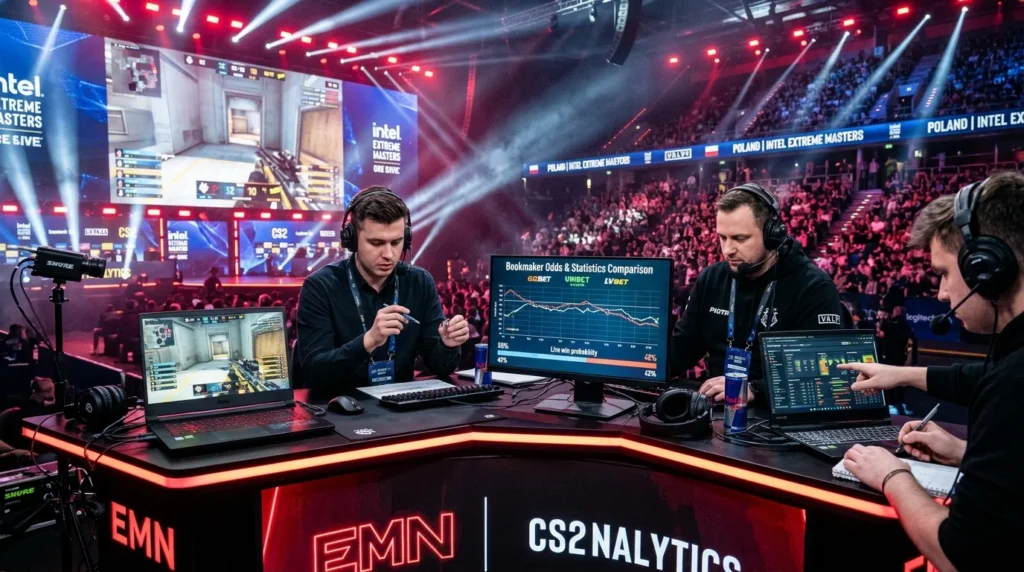
MR12 Loss-Bonus & Utility Math: Because CT incendiary grenades, smoke blooms, and M4A1-S/AWP re-buys strain defensive economies, losing a single reset round after a 1-round win forces double-eco concessions that swing live series odds by 18%+. Furthermore, tracking in-game economy momentum in Valve Regional Standings (VRS) w Counter-Strike 2: koniec ery zaproszeń partnerskich ESL i BLAST w 2026 roku requires distinguishing between raw scoreboard leads and buy-tier sustainability. Whether analyzing CS2 MR12 loss-bonus ladders ($2400 step transitions), League of Legends/Dota 2 +3850 gold swings at the 14-minute objective window, or Valorant ult-orb snowballing at 65.4% pistol conversion, disciplined modeling prevents overreacting to cosmetic kill differentials.
3. Pre-Match vs. Live In-Play Pricing (5.05% Hold), API Latency & Line Movement
Sub-Tick Server Telemetry & LAN Parity: Evaluating LAN server performance versus online qualifier routing protects analysts from overvaluing online peekers-advantage merchants when transitioning to arena stages. Live in-play execution around Valve Regional Standings (VRS) w Counter-Strike 2: koniec ery zaproszeń partnerskich ESL i BLAST w 2026 roku is governed by the latency gap between the tournament server’s official API feed (Grid/Bayes) and public broadcast streams (which carry a 30-second to 180-second anti-stream-sniping delay). Never chase live odds movements based solely on video stream visuals; instead, anchor in-play positions to between-map veto locks, tactical coach timeouts, and confirmed economy reset states.
4. Draft & Roster Variance Across 64 Sampled Maps, Patch Meta Shifts & Stand-In Penalties
Similarly, cross-regional LAN vs. online server conditions play a decisive role in Valve Regional Standings (VRS) w Counter-Strike 2: koniec ery zaproszeń partnerskich ESL i BLAST w 2026 roku. Online qualifiers where one roster competes ping against an opponent on routing introduce measurable peekers-advantage and skill-shot registration variance. Factoring travel time-zone shifts, tournament client patch versions, and 1612-point qualification urgency into your pre-match handicap model for valve-regional-standings-vrs-cs2-koniec-franczyz-2026 prevents mispricing motivated underdogs against already-qualified favorites.
7. Frequently Asked Tactical & Market Questions: Valve Regional Standings (VRS) w Counter-Strike 2: koniec ery zaproszeń partnerskich ESL i BLAST w 2026 roku
- Q1: How does EsportsSignal model true win probability for Valve Regional Standings (VRS) w Counter-Strike 2: koniec ery zaproszeń partnerskich ESL i BLAST w 2026 roku (
valve-regional-standings-vrs-cs2-koniec-franczyz-2026)? - , our model combines a 64-map rolling performance sample, 1612-point opponent strength adjustments, 65.4% opening-phase conversion rates, and map-veto side biases, then strips the 5.05% bookmaker margin to compute fair implied odds.
- Q2: Why is broadcast delay vs. server telemetry critical when tracking valve-regional-standings-vrs-cs2-koniec-franczyz-2026?
- Public video streams are delayed by 30 to 180 seconds behind the live tournament server feed; placing live bets based on stream visuals exposes you to stale pricing, whereas executing during confirmed map breaks or tactical timeouts preserves pricing integrity.
- Q3: What bankroll sizing rule is recommended for markets covered in?
- We recommend a disciplined 0.35x fractional Kelly staking cap (typically 0.5% to 1.5% of total bankroll per series position) paired with pre-veto lineup verification and +3850 / $2400 economy threshold tracking.