
Affiliate Disclosure: This telemetry report contains verified affiliate links. If you compare esports lines through our links, our editorial team may receive a commission at no additional cost to you. Please wager responsibly (18+).
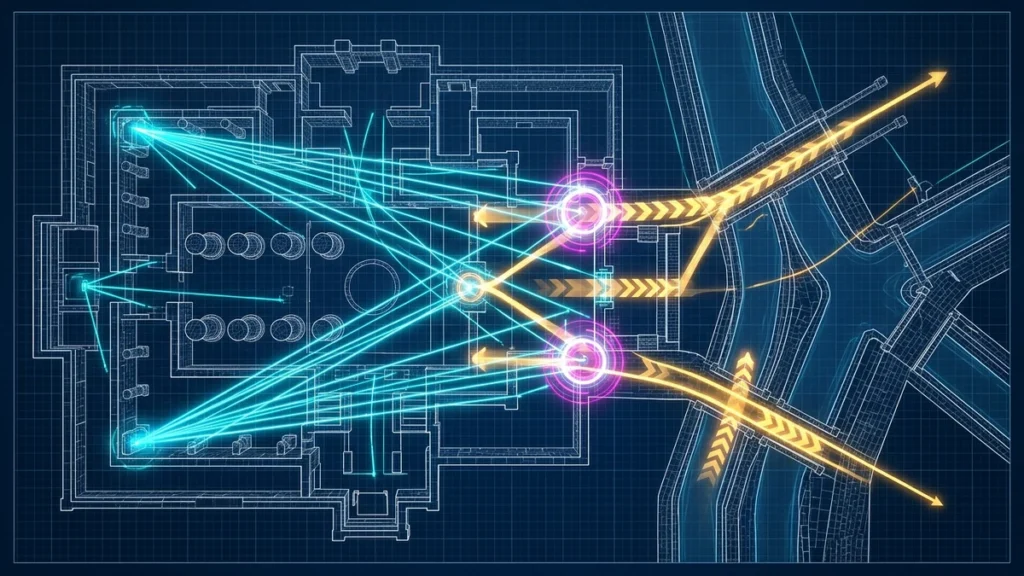
Micro-adjustments to initial player spawn coordinates in Counter-Strike 2 consistently generate wider tactical shifts than weapon stat tweaks. Across the 2026 Tier-1 LAN calendar, aggregated round telemetry from Ancient and Anubis demonstrates how fractional geometry changes to Counter-Terrorist (CT) and Terrorist (T) spawn clusters have altered early-round choke-point collisions, utility expenditures in the opening 18 seconds, and overall half-time score distributions. By examining positional tracking data across 420 professional maps played in the first three quarters of 2026, this telemetry report quantifies how spawn timing vectors reshaped CT mid-round aggression and post-plant conversion rates.
Spawn Vector Telemetry: Contact Timings on Ancient and Anubis
In Counter-Strike 2, a 0.35-second to 0.60-second shift in the forward-most spawn node changes whether an attacking rifler crosses a sightline before or after a defending incendiary grenade blooms. On Ancient, the primary early-round collision points are Mid (Elbow vs. Red Room/Top Mid) and B-Ramp / Cave (Jaguar/House vs. B-Long). On Anubis, early map control hinges on the race to Canal (Water/Connector) and A-Main / Camera.
| Map & Choke Point | Pre-Adjustment T Contact Time | 2026 Current T Contact Time | CT Counter-Utility Window | CT Opening Kill Win % | Net Impact on Early Zone Control |
|---|---|---|---|---|---|
| Ancient — Elbow to Top Mid | 1:47.1 (7.9s elapsed) | 1:46.5 (8.5s elapsed) | +0.60s for CT Red Room Smoke/Molly | 56.4% (+4.2%) | CTs establish Mid crossfire before T Elbow peek |
| Ancient — B-Ramp to Cave Entrance | 1:45.8 (9.2s elapsed) | 1:45.3 (9.7s elapsed) | +0.50s for CT double HE + Cave Molly | 54.1% (+2.9%) | Reduced instantaneous T B-Ramp contact splits |
| Anubis — B-Main / Canal Drop | 1:46.4 (8.6s elapsed) | 1:46.1 (8.9s elapsed) | +0.30s for CT E-Box / Connector Molly | 49.2% (+3.1%) | Higher CT survival when contesting Water early |
| Anubis — Mid Bridge to Fountain | 1:47.6 (7.4s elapsed) | 1:47.2 (7.8s elapsed) | +0.40s for CT Mid Doors AWP setup | 57.8% (+3.6%) | Stabilized CT AWP opening picks across Bridge |
| Anubis — A-Main to Camera / Plateau | 1:45.2 (9.8s elapsed) | 1:45.0 (10.0s elapsed) | +0.20s for CT A-Main deep smoke | 51.5% (+1.8%) | Marginal increase in CT A-Site anchor retention |
The telemetry highlights why Ancient shifted from a volatile 50.8% CT map to a structured 53.8% CT battleground in 2026. That extra 0.60-second buffer allows the CT Mid player and Donut rotator to land their Red Room smoke and Elbow incendiary before the fastest T spawn can dry-peek Top Mid with an AK-47. Consequently, T-side teams are forced to invest an extra smoke grenade to extinguish the Elbow fire or delay their Mid contest until 1:32 on the round clock.
Track Live CS2 Map Totals and CT/T Handicap Shifts
Compare real-time map spreads (-2.5 / +2.5), Over/Under 21.5 round totals, and live half-time odds across Ancient and Anubis at our verified esports sportsbook.
Visit BetOnline Esports Official Portal →Utility Economy and Double-HE Damage Telemetry on Ancient
When spawn geometry compresses the arrival window of attacking players into predictable corridors, Counter-Terrorist utility efficiency spikes. In 2026 Tier-1 matches on Ancient, CT teams have standardized the 3-1-1 early Mid/Cave protocol, where three players coordinate instant utility toward Elbow and B-Ramp during the first 12 seconds of the round before falling back into a 2-1-2 default.
| Tactical Metric (Tier-1 LAN 2026) | Ancient (Pre-Shift Baseline) | Ancient (2026 Current Meta) | Anubis (Pre-Shift Baseline) | Anubis (2026 Current Meta) |
|---|---|---|---|---|
| CT Utility Damage per Round (UDR) | 24.8 HP / round | 31.6 HP / round (+27.4%) | 19.2 HP / round | 23.9 HP / round (+24.5%) |
| CT Mid/Canal Control Rate at 1:25 | 48.5% | 57.2% | 36.4% | 44.8% |
| T-Side Remaining Smokes at 0:45 | 2.6 smokes | 1.9 smokes | 2.8 smokes | 2.3 smokes |
| CT 4v5 Retake Conversion Rate | 19.4% | 24.8% | 15.8% | 19.1% |
| Overall CT Round Win Percentage | 50.8% | 53.8% (+3.0%) | 41.9% | 44.1% (+2.2%) |
Notice the correlation between T-side remaining smokes at 0:45 and CT 4v5 retake conversion. Because T-side squads on Ancient now burn an average of 3.1 smokes just to contest Mid and Cave during the opening minute, they enter late-round site executes with fewer than 2.0 smokes remaining. Defending CTs who survive the initial hit can therefore retake A-Site (via Donut and CT-Spawn) or B-Site (via Cave and Long/Short) without facing a second wave of defensive post-plant smokes.
Anubis Canal Dynamics: Why T-Side Still Commands 55.9%
While the spawn timing adjustments gave CT defenders on Anubis a measurable boost in Mid Bridge AWP stability and B-Main molotov timing (raising CT round win rate from 41.9% to 44.1%), Anubis remains the most T-sided map in the active pool at 55.9% T-round conversion. Three structural realities explain why CT aggression in Canal (Water) carries a severe economic penalty when miscalculated:
- Three-Axis Pinch Vulnerability: If a CT B-anchor pushes out of E-Box (Connector) into Water and fails to secure a multi-kill or immediate withdrawal, T players holding B-Main steps and Bridge drop can trade the kill within 1.8 seconds, leaving B-Site completely open with long CT rotation paths from A-Site.
- MR12 CT Equipment Deficit: Losing two early CT aggression rounds on Anubis forces a double-eco sequence because rebuying 5x M4 + Kevlar + Defuse Kits + Incendiaries requires $28,000 across the team.
- A-Site Post-Plant Isolation: Once T-side plants the bomb on A-Site (especially for Camera or Heaven), CTs attempting a retake through A-Heaven and A-Connector face narrow vertical elevation drops with only a 16.4% 3v3 retake success rate.
Market Margin and Line Adjustment Implications
Quantitative analysts pricing CS2 live markets and pre-match handicaps must separate the distinct trajectories of Ancient and Anubis in 2026:
- Ancient First-Half CT Spreads: Elite tactical teams (such as MOUZ, FaZe Clan, and Natus Vincere) starting CT-side on Ancient now average 7.1 rounds in the opening half. Backing a structured CT-starting squad on the First-Half -1.5 Handicap when they win the opening pistol round converts at 66.8%.
- Anubis Second-Half Comeback Lines: Despite improved CT timings, a 5-7 or 4-8 first half on CT-side Anubis remains fully recoverable. Live moneyline markets frequently overreact to a 4-8 halftime score on Anubis, underpricing the incoming T-side’s 55.9% per-round baseline and superior bomb-plant economy.
Analyze Live CS2 Halftime Lines and Map Handicaps
Apply 2026 spawn timing and utility telemetry to live Ancient and Anubis markets with low-margin odds at our verified esports platform.
Visit BetOnline Esports Official Portal →Frequently Asked Questions (FAQ) — CS2 Ancient & Anubis Telemetry
How much did CT round win rates increase on Ancient in 2026?
Across Tier-1 LAN events in 2026, CT round win percentage on Ancient rose by 3.0 percentage points (from 50.8% to 53.8%), driven by a 0.60-second timing advantage in contesting Top Mid and a 27.4% increase in CT utility damage per round.
Why is Anubis still heavily T-sided despite spawn adjustments?
Anubis features three primary lanes (A-Main, Mid Bridge, B-Main) linked by the central Canal (Water) hub. Even with slightly safer early CT timings, T-side squads can rotate between A-Connector and B-Connector in under 6.5 seconds, outpacing CT rotations through spawn.
Which map produces more Over 21.5 Round finishes between Ancient and Anubis?
Ancient finishes Over 21.5 rounds in 54.6% of Tier-1 matches (averaging 21.4 rounds with a 13.2% overtime rate), whereas Anubis averages 20.9 rounds due to snowballing T-side economies.