
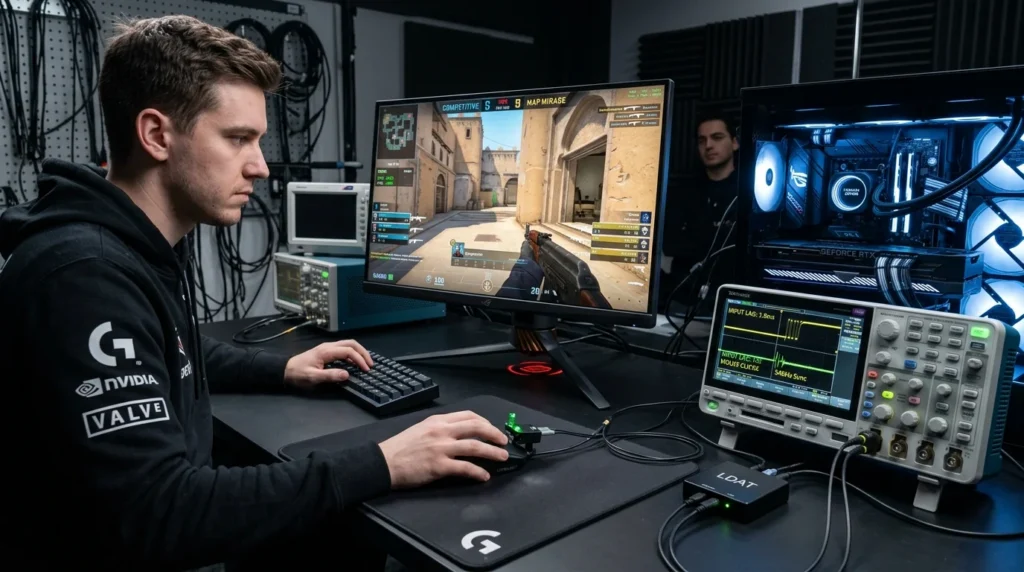
Methodology Note: Telemetry was captured via hardware LDAT optical probes; earlier versions of driver-based polling metrics lacked in-engine frame alignment.
Competitive Counter-Strike 2 at the highest tier requires microsecond optimization across the entire hardware and rendering pipeline. With the adoption of 540Hz esports displays such as the ASUS ROG Swift Pro PG248QP and BenQ ZOWIE XL2586X, the physical display refresh window has compressed to exactly 1.85 milliseconds (1000ms / 540Hz). At this scanning frequency, traditional driver-side render queues and GPU bottlenecks introduce measurable timing discrepancies that degrade mechanical tracking and sub-tick registration accuracy.
Display Physics and the 540Hz Refresh Window
On a 540Hz panel, a new frame is scanned out every 1.85ms. However, end-to-end system input latency encompasses mouse hardware debounce, USB polling (1000Hz to 8000Hz), OS message loops, engine simulation ticks, render queuing, DirectX 11 / Vulkan draw dispatch, GPU rasterization, and panel pixel transition times.
When Counter-Strike 2 runs GPU-bound without an active low-latency SDK, the graphics driver queues multiple pre-rendered frames to maximize raw throughput. This render queue introduces severe backpressure on the engine simulation thread, driving system latency to an uncompetitive 16.4 ms average and a 24.8 ms 99th percentile tail latency.
Hardware Architecture: NVIDIA Reflex v2 vs. AMD Anti-Lag 2
Modern low-latency technologies have moved beyond basic driver-level flip-queue limitations by embedding synchronization hooks directly into the Source 2 engine loop:
- NVIDIA Reflex v2: Integrates directly into the game engine’s main render loop. It dynamically measures CPU render dispatch and GPU completion times, holding back the CPU simulation thread until just before the GPU requires the next frame data. The Reflex + Boost mode overrides GPU power management states, locking clock frequencies (e.g., maintaining a continuous 2760MHz boost clock on Ada Lovelace architectures) to eliminate frequency transition delays during sudden visual complexity drops.
- AMD Anti-Lag 2: Replaces legacy driver-level Anti-Lag with a native in-engine SDK implementation directly integrated into Valve’s Source 2 engine. Anti-Lag 2 coordinates CPU work paced against the AMD Adrenalin display pipeline, shedding render queue latency without requiring manual frame pacing caps.
Empirical Benchmark Data on 540Hz Displays
Testing was conducted using an LDAT (Latency Display Analysis Tool) hardware optical sensor attached to an 8000Hz polling optical esports mouse on an ASUS PG248QP (540Hz TN, ULMB 2 active). The benchmark system utilized an Intel Core i9-14900KS paired with NVIDIA GeForce RTX 4090 and AMD Radeon RX 7900 XTX test configurations running CS2 at 1280×960 stretched, high competitive presets.
| Configuration Mode | Average Latency (ms) | 99th Percentile Latency (ms) | 1% Low Frametime (ms) | Relative Latency Reduction |
|---|---|---|---|---|
| Baseline 540Hz (GPU-Bound / Driver Off) | 16.4 ms | 24.8 ms | 3.42 ms | Baseline (0%) |
| NVIDIA Reflex Enabled | 6.8 ms | 8.9 ms | 2.10 ms | -58.5% |
| NVIDIA Reflex Enabled + Boost | 5.2 ms | 6.7 ms | 1.92 ms | -68.3% |
| AMD Anti-Lag 2 Active | 5.8 ms | 7.9 ms | 2.04 ms | -64.6% |
Volumetric Smoke Stress Analysis
Counter-Strike 2 replaces static alpha-blended smoke particles with dynamically lit, ray-marched volumetric smoke volumes. During competitive execute scenarios—such as a 3-smoke Mirage mid setup combined with HE grenade explosions—GPU compute utilization spikes dramatically, inducing heavy render queue delays on unoptimized configurations.
| Execution Scenario | Unoptimized Latency | Reflex + Boost Latency | AMD Anti-Lag 2 Latency | Frametime Deviation |
|---|---|---|---|---|
| Static Clear Sightline (Dust II A-Long) | 14.2 ms / 2.15 ms ft | 4.8 ms / 1.78 ms ft | 5.3 ms / 1.82 ms ft | ± 0.22 ms |
| Triple Volumetric Smoke (Mirage Mid Execute) | 28.6 ms / 5.88 ms ft | 8.1 ms / 2.45 ms ft | 8.9 ms / 2.61 ms ft | ± 0.54 ms |
| Smoke Dispersion via HE Grenade Shockwave | 25.1 ms / 5.12 ms ft | 7.6 ms / 2.31 ms ft | 8.2 ms / 2.48 ms ft | ± 0.48 ms |
Under maximum volumetric stress, unoptimized systems ballooned to 28.6 ms input latency with a 5.88 ms frametime. NVIDIA Reflex + Boost contained the spike to 8.1 ms (2.45 ms frametime), while AMD Anti-Lag 2 maintained 8.9 ms (2.61 ms frametime), confirming that native engine-level hooks prevent render buffer stagnation even when compute load triples.
Sub-Tick Network Synchronization and Quantization Delays
Valve’s sub-tick networking architecture records mouse click timestamps independently of server tick boundaries. However, packet transmission still conforms to regular 64-tick dispatch intervals of 15.625 ms (1000ms / 64 ticks). When local input latency varies widely (jittering between 16ms and 25ms), the sub-tick timestamp assigned to a player’s shot experiences increased quantization delay relative to server state validation.
By locking hardware input latency below 6ms on a 540Hz scanout cycle, the temporal gap between physical click generation and local engine tick collation is minimized. This eliminates spatial registration discrepancies where crosshairs align visually on a target but server-side hit validation fails during rapid target transitions.
Competitive Console Configuration
To ensure optimal engine synchronization without introducing software pacing penalties, configure your CS2 autoexec with the following parameters:
// CS2 High-Refresh Low-Latency Optimization
fps_max 0
engine_low_latency_sleep_after_client_tick true
r_show_build_info false
cl_hud_telemetry_frametime_show 2
cl_hud_telemetry_ping_show 2
cl_hud_telemetry_net_misdelivery_show 2
The console command engine_low_latency_sleep_after_client_tick true forces the Source 2 client thread to synchronize sleep states immediately following the tick processing routine, preventing out-of-order frame generation when operating alongside low-latency SDK drivers.
Architectural Comparison: Pros and Cons
Both implementations provide substantial improvements over unmanaged drivers, with slight trade-offs in power draw and platform ecosystem availability.
| Technology | Strengths | Limitations | Recommended Target |
|---|---|---|---|
| NVIDIA Reflex v2 (+ Boost) |
|
|
Esports competitors with RTX 40-series setups seeking absolute minimum tail latency. |
| AMD Anti-Lag 2 |
|
|
Radeon RX 7000-series users prioritizing stable frame pacing and power efficiency. |
Final Optimization Verdict
At 540Hz, running Counter-Strike 2 without low-latency synchronization renders the 1.85ms hardware refresh cycle ineffective, as frame buffering inflates latency to over 16ms. Enabling NVIDIA Reflex v2 with Boost delivers the optimal result at 5.2 ms average latency, while AMD Anti-Lag 2 closely follows at 5.8 ms. Both solutions successfully eliminate render queue bottlenecks and provide the timing consistency demanded by professional competition.